
Press Release: CSSE Releases Election Guides for Law Enforcement in All 50 States
Updated state-specific guides provide law enforcement with practical information to help protect election workers, voters, and election infrastructure amid an evolving threat environment
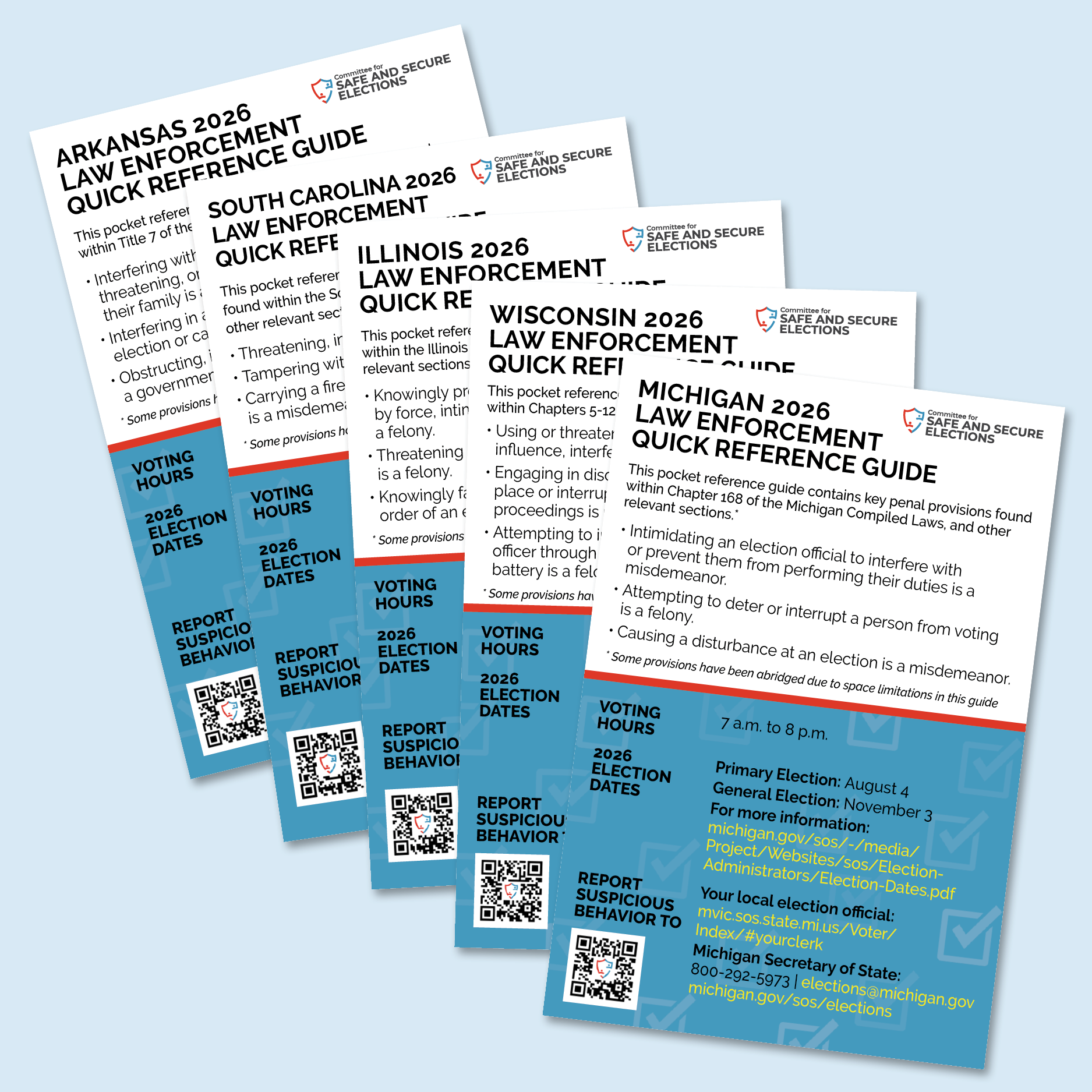
WASHINGTON, D.C. — June 15, 2026 — Today, the Committee for Safe and Secure Elections (CSSE) announced the release of updated Quick Reference Guides for law enforcement for all 50 states and Washington, D.C., providing officers, agencies, first responders, and election officials with state-specific information to help prepare for and respond to security challenges ahead of the 2026 midterm elections.
Each guide has been updated for 2026, and provides practical, accessible information on relevant election and penal laws in every state for use by law enforcement, election officials, and their partners. The guides are designed to support preparation and coordination between election officials and law enforcement before, during, and after Election Day.
“Safe and secure elections do not happen by accident. They require preparation, trust, and clear lines of communication between the people who administer elections and the people responsible for protecting them,” said Tina Barton and Christopher Grotton, Co-Chairs of the Committee for Safe and Secure Elections. “These guides are one of CSSE’s most important tools for helping communities prepare for the 2026 midterms. They give law enforcement the state-specific information they need to respond appropriately, protect voters and election workers, and help ensure the voting process continues safely and securely.”
The release comes as election officials and law enforcement prepare for a multi-domain threat environment heading into 2026. Emerging technologies are lowering the barrier to disruption. What once required physical presence and coordination can now be executed remotely, scaled quickly, and deployed in ways that exploit legal gray areas and operational gaps. Artificial intelligence is increasingly being used to generate convincing hoaxes, impersonate trusted officials, and spread disinformation faster than traditional response mechanisms can keep up.
At the same time, many election offices and local public safety agencies remain underfunded and under-resourced. CSSE’s guides are intended to help fill that gap by providing practical, state-specific tools accessible to anyone.
“These guides were created to solve a very practical problem: law enforcement officers are often called upon to help protect election workers, voters, and facilities, but they may not have easy access to the election-specific rules and procedures that apply in their state,” said Neal Kelley, the creator of the guides and former Registrar of Voters for Orange County, California. “The goal has always been to give officers clear, reliable information before they need it in the field.”
“Election laws change, threat environments change, and preparation has to keep pace,” said Kathy Boockvar, the former Pennsylvania Secretary of the Commonwealth, who oversees updates to the guides. “These guides are updated each year to reflect evolving legal standards and real-world operational needs in every state, and to support the kind of coordination that can make all the difference when officials are responding under pressure.”
In 2024, CSSE printed more than 100,000 pocket guides for law enforcement and other officials, with many more distributed electronically. The organization expects to surpass that number in 2026 as it expands its training, scenario planning, and resource distribution efforts nationwide.
As part of its broader 2026 preparation work, CSSE will host or contribute to more than 100 trainings and scenario planning exercises before the end of the year across dozens of states. Since its founding in 2022, CSSE has presented nearly 300 times in more than 40 states.
In addition to downloading and sharing the guides, CSSE encourages election officials, law enforcement agencies, associations, and community partners to contact the organization for training, tabletop exercises, and support in strengthening local election security partnerships.
The full set of guides is available now at safeelections.org/referenceguides. All guides are available for download and can be printed locally by agencies and offices. CSSE also offers the option to print guides through its trusted vendor for fast, reliable delivery.
About the Committee for Safe and Secure Elections
The Committee for Safe and Secure Elections features cross‑partisan experts in election administration and law enforcement who aim to support policies and practices that protect election workers and voters from violence, threats, and intimidation. The Committee also works to build relationships and trust between election officials and law enforcement to better equip both to prevent and respond to threats and violence against voters and election workers.
Related News



Get Involved


Law Enforcement Quick Reference Guides summarize key penal provisions found within state law.